
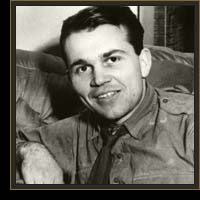
In February 1943, war correspondent and journalist for the Stars and Stripes was selected as one of eight journalists to accompany the 8th Air Force on bombing missions over Germany. After a week's extensive training, Rooney, the youngest of the journalists, joined the 306th Bomb Group and assigned to fly with Bill Casey’s B-17 “Banshee II” crew on aircraft #41-24488, on a mission to Wilhelmshaven, Germany. The aircraft was hit by flak and Rooney believed that gave him the best story of all the journalists. Rooney recalled:
“'I got in my bomber and I thought to myself, Why am I doing this? I'm scared to death. I mean, I don't have to risk my life except that I felt so bad for all the men who did have to risk their lives all those times that it just seemed like it was the honest thing to do.
If there was flak before you got to the target, the pilot could take evasive action. But once the bombsight zeroed in on the target, you couldn't take any evasive action or the bombs would not go where they were designed to go. That plane was a perfect target for the German gunners from underneath, and that was the frightening part of it — you just had to sit there.
I was up in the nose of the plane, and a shell came in and took a small piece of the Plexiglas nose off. The bombardier (Jim McCracken), who was in front of me, panicked and tried to stuff something in the hole. At seventeen or eighteen thousand feet, that air coming in is subzero, and he took his gloves off. His hands froze and it was terrible. I looked across at the little desk that the navigator (Bill Owens) used. His oxygen tube had been pierced and he lost his oxygen, and at eighteen thousand feet he collapsed. So I got to the pilot intercom and I asked him (Casey) what to do. He said, "Well, we have emergency air in oxygen bottles up behind me. Take some deep breaths and come back up behind me and get the oxygen bottle; bring it back down and hook him up to that."
Well, I didn't know how to do any of this, and here I was, with somebody's life at stake, and I didn't know how long you lasted once you took your oxygen mask off. But I took some deep breaths, I took my oxygen mask off, and went through this alleyway up behind the pilot. There I got an oxygen bottle and hooked up the navigator, who was a much more experienced flyer than the bombardier (McCracken had only been with the 306th for five days and was flying his first mission). He regained consciousness and got the bombardier quieted down. So I had by far the best story to tell of all the correspondents who went out that day”'
Although Rooney had a harrowing experience, another journalist Robert Post was killed when his aircraft exploded in mid-air, Therefore, it was deemed too dangerous for journalists to fly further missions with the 8th Air Force, but Rooney accompanied a B-26 Marauder crew on D-Day. He was also one of the first journalists to visit concentration camps and was awarded the Bronze Star and the Air Medal for his reporting throughout the Second World War.
Two months later on April 17, 1942, the Banshee II was shot down on a mission to Bremem, Germany. The five crewmen behind the bombay were all killed, and the five in front including Casey, McCracken, and Ownes) were captured and became prisoners of war.