
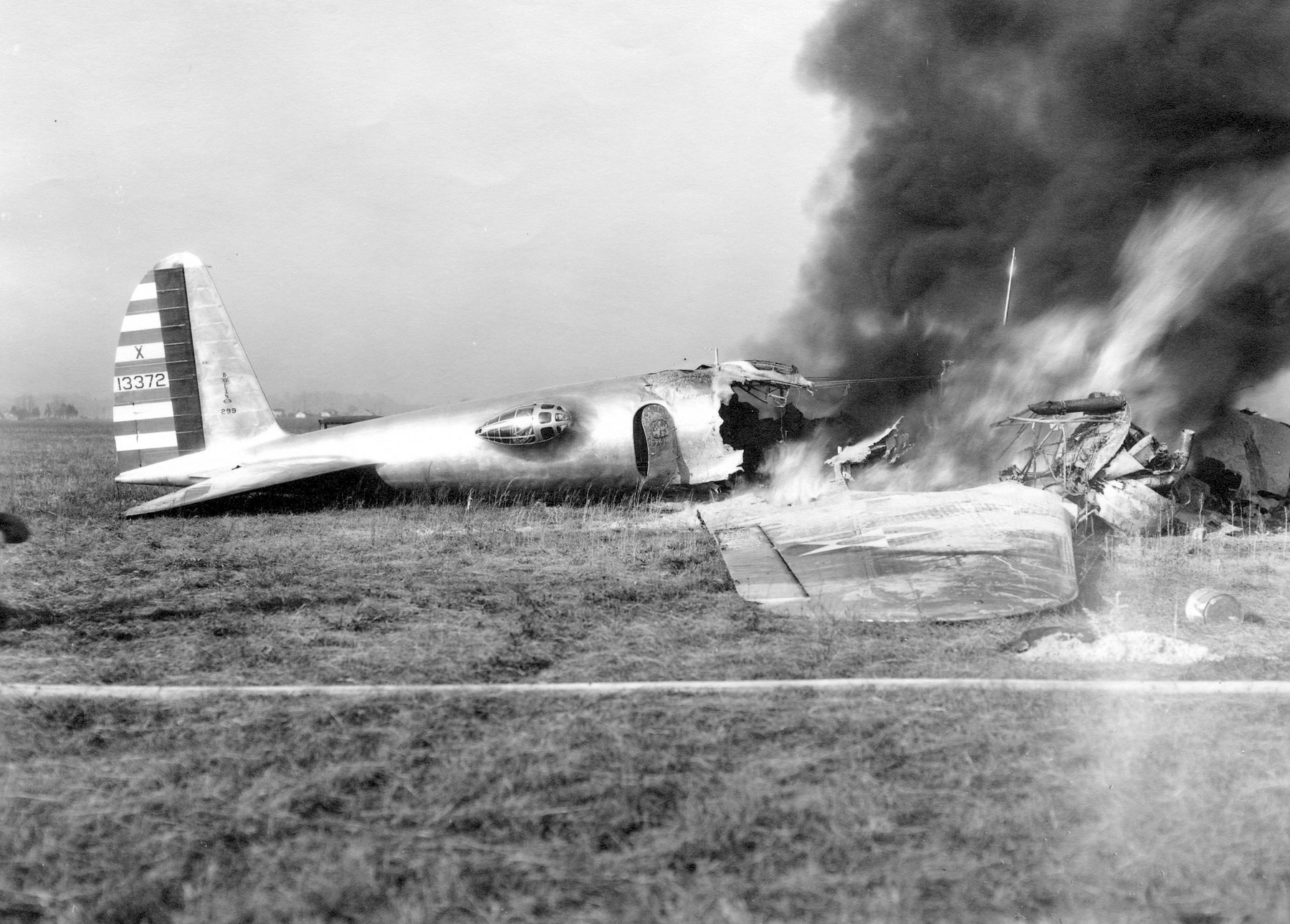
While undergoing evaluation by the U.S. Army Air Corps at Wright Field, northeast of Dayton, Ohio, the Boeing Model 299 Flying Fortress, X13372—the most technologically sophisticated airplane of its time—took off on its second test flight.
Major Ployer Hill, the Chief of the Flying Branch, Material Division, at Wright Field, was the pilot, and it was his first flight in the airplane. The co-pilot was the Air Corps’ project pilot, Lieutenant Donald Leander Putt. Boeing’s Chief Test Pilot Leslie R. Tower and company mechanic C.W. Benton was also on board, as was Henry Igo of the Pratt & Whitney Aircraft Company.
Immediately after takeoff, the 299 suddenly pitched up, stalled and crashed, then caught fire. Three men, Igo, Benton and Putt, were able to escape from the wreck despite injuries. However, both Hill and Tower died of their injuries.
The official investigation of the crash determined that the prototype bomber’s flight crew had neglected to release the flight control gust locks which are intended to prevent damage to the control surfaces while on the ground.
Experts wondered if the Flying Fortress was too complex an airplane to fly safely. As a direct result of this accident, the “check list” was developed; now required in all aircraft.
After several years of testing, the Model 299 went into production as the B-17 Flying Fortress. By the end of World War II, 12,731 B-17s had been built by Boeing, Douglas Aircraft and Lockheed Vega.