
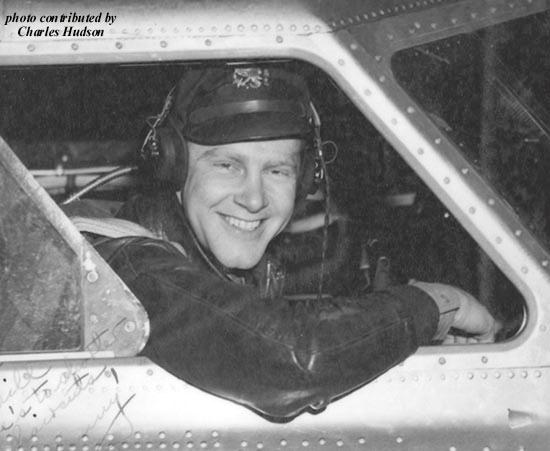
Twenty-seven-year-old Lt. Col. Immanuel "Manny Klette", son of a Lutherana minister who had emigrated from Germany before World War II, reported to the 306 th Bomb Group/369 th Bomb Squadron on March 12, 1943, when an American bomber crewman’s life expectancy was fifteen missions. When he completed his 25-mission tour, Klette was confident he could survive another tour. His group commander approved only five additional missions.
On September 23, 1943, returning to Thurleigh from a mission to Nantes, France, in B-17 AC 42-3449, it came close to being his last. With the two right engines knocked out by flak, a perforated fuel tank that wouldn’t seal, and a leg wound, he was forced, after a third engine quit, to crash land with one flat tire at night under instrument conditions in woods near RAF Wing, Bucks. All the crew survived, but Klette spent five months in hospitals with fractures of the pelvis and upper legs.
The doctors said he would never fly again, or even walk normally. Klette didn’t agree. He asked for a ground assignment in the UK until he could return to operations. As a briefing officer in General Carl “Tooey” Spaatz’s United States Strategic Air Forces (USSTAF) headquarters, he made a thorough study of Eighth Air Force operational strengths and weaknesses, German targets, Luftwaffe tactics, and an analysis of when and how the Germans changed their flak dispositions.
Klette finally won his battle with the flight surgeons. On July 30, 1944, he was given command of the 324th Squadron, 91st Bomb Group at Bassingbourn; one of its radar-equipped Pathfinder squadrons. “I asked him to stay on the ground more, said his commanding officer. But he continued to go. I got my dander up and ordered him only to go when his turn to lead came up. He still went. What the hell are you going to do with a man like that?”
On April 25, 1945, Lt. Col. Immanuel Klette landed his B-17 at the end of a nine-hour mission to Pilsen, Czechoslovakia. It was the last day of the strategic bombing campaign in Europe. Twelve days later, Germany surrendered unconditionally.
Klette didn’t know at the time that he had set a record for heavy bomber pilots unlikely ever to be equaled. He had flown 91 missions totaling 663 combat hours–20 more than his closest runner-up and 66 beyond the standard 25-mission tour.