
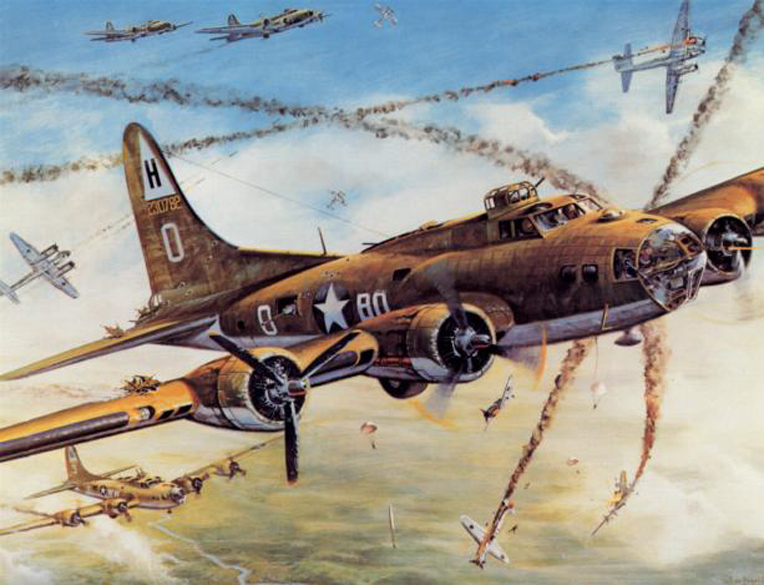
During 1943, the 8th Air Force suffered devastating losses because the Allied fighters at the time did not have the fuel capacity to escort the bombers deep into Germany and back to their bases. The losses culminated in October during Black Week when over four bombing missions into Germany 148 bombers were lost; almost 1,500 men.
The worst day was Black Thursday, October 14 when two hundred and ninety-one B-17s were sent to hit the ball bearing factories at Schweinfurt, Germany and sixty were lost. Ten of the fifteen B-17s of the 306th Bomb Group to bomb the target were shot down. The mission is referred to as Second Schweinfurt because an earlier mission was flown on August 17.
369th Capt Charles Schofield led the 306th Bomb Group. Troubles began early when only two of the three groups of the 40th Combat Wing made rendezvous, the 92nd and the 306th. As the German fighter attacks started, the two bomb groups found themselves in serious difficulty, and the hundreds of fighters overwhelmed the bombers.
367th Douglas White was the first plane shot out of the formation, and moments later Willard Lockyear’s. 423rd John Jackson’s plane went down at 1415 and about twenty minutes after the target, William Bisson’s 367th plane was hit by flak and finished off by enemy fighters. One of the planes lost in the confusion of the intense fighter onslaught was the 369th aircraft of George Bettinger. Just past Frankfurt as another wave of fighters continued the assault, Gustave Holmstrom’s 369th “Piccadilly Commando” went down. To their dismay, Ralph Peters and his 369th crew learned about German airborne rockets, but all were able to bail out before the plane exploded. One of the earlier planes to leave the formation was the 423rd aircraft of Vernon Cole which was hit by a rocket in the bomb bay. Robert McCallum flying the 423rd “Queen Jeannie” who was the co-pilot when Snuffy Smith earned his Medal of Honor went down. Richard Butler was the pilot of a 367th plane in which all the crew survived.
Thus ended one of the three worst days in the combat history of the 306th Bomb Group. It was a shattered five crews that returned, and it was a stunned and saddened Thurleigh that received them. Many could not believe what had happened.
Of the one hundred men who did not return to Thurleigh that afternoon, thirty-five died on the mission or later of wounds. Sixty-five went to prison camp, eventually returning with a variety of experiences.