
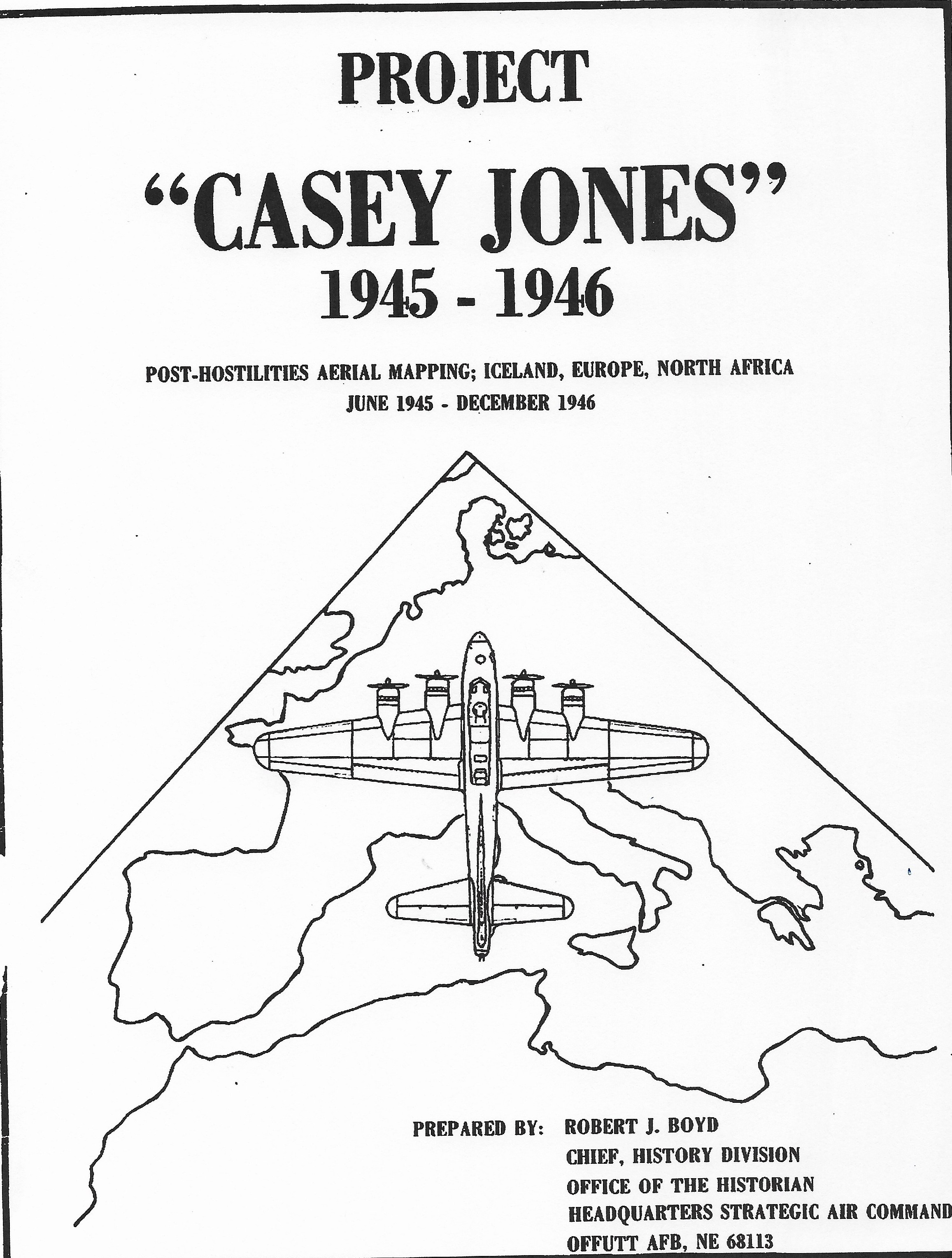
When the war ended, the Eighth Air Force was disbanded and moved back to theUnited States for redeployment to the Pacific theater. However, the 306th BombGroup was assigned to complete an aerial mapping project of Western Europeand North Africa code named “Casey Jones”.
The Casey Jones Project was initiated due to the lack of adequate maps and chartshad caused serious difficulties for the American ground forces during theEuropean campaign. A requirement thus existed for accurate maps for fire control, fire direction, and terrain feature profiles. The scope of the mapping project was more than two million square miles.
On 16 May 1945, the 306 th Bomb Group along with the 305 th Bomb Group werereassigned from the 8 th Air Force to the 9th Air Force which became the Air Armyof Occupation for Germany. The Group moved to Giebelstadt, Germany onDecember 1, 1945, and then to Istres, France on February 28, 1946.
The Groups were to take high-altitude photographs of designated areas in such amanner that detailed maps of a scale of 1:25,000 could be drawn from theoverlaid mosaics of the picture prints. The B-17s were modified by removing allarmament and outfitted with a K/20 camera mounted in the radio room.
Photomapping was a novel mission for these bomber units, but the objective wasto produce accurate maps ideally suited to the needs of the ground forces. Initialestimates predicted that it would take years of preparation to complete themapping project. The flying portion was completed in less than 18 months. Records are incomplete, but the two groups flew thousands of sorties using up tens of thousands of flying hours on the effort.
On December 25, 1946, the project was completed and the units inactivated.
Steve Snyder, President